Top rated
1 / 5
City Tour
Malé: 3 Hour Malé City Walking Tour
Male City, Kaafu Atoll4.9(33 reviews)Operated by Follow Me to Maldives
Top rated · City Tour · Male City
Loved by travellers · 4.9/5 (33)
3 hrs
Max 100 people
Guide
English
Standard cancellation
Most visitors to the Maldives never leave their resort island — and they miss an entire world. This 3-hour guided walking tour takes you deep into Malé, the Maldives' extraordinary capital: ancient coral-stone mosques, a fish market that feeds a nation, royal gardens, and streets alive with real Maldivian culture. Led by an expert local guide from Follow Me To Maldives, it's the most authentic experience you can have on a layover, port stop, or day in the capital.
- Visit the 1658 Hukuru Miskiy (Old Friday Mosque) — the oldest coral-stone mosque in the Maldives, a masterpiece of Islamic architecture
- Experience the famous Malé Fish Market and Local Market — the sensory heart of authentic Maldivian daily life
- Explore Sultan Park and the National Museum, set in the former royal palace grounds, filled with pre-Islamic treasures
- See Parliament House, Republic Square, and the Presidential Palace with stories from a certified expert local guide
- Perfect for cruise passengers, Velana Airport layovers, and first-time visitors wanting more than just a beach
Included
- Expert English-speaking local guide
- 3-hour guided walking tour of Malé City
- Visits to Hukuru Miskiy (Old Friday Mosque), Sultan Park, Fish Market, Local Market, and key landmarks
- Cultural and historical commentary at every stop
- All applicable taxes and fees
Not Included
- Food, drinks, and market purchases
- Transport to and from the meeting point
- Tips and gratuities (optional but appreciated)
- National Museum interior entry fee (if visiting inside)
Activity
Meeting Point
Your tour begins here, at the Henveiru Ferry Terminal opposite Maagiri Hotel. Your Follow Me To Maldives guide will be waiting to welcome you and give you a quick briefing before setting off. This is one of Malé's main inter-island ferry hubs, so even at the starting point you're already witnessing authentic local life in motion — a fitting introduction to everything that follows.
One of the oldest and most respected schools in the Maldives, Majeedhiya School has shaped generations of Maldivian leaders, scholars, and public figures since its founding. The colonial-era architecture stands as a striking contrast to the modern buildings around it, and the school's history tells a larger story about how education and identity evolved across this island nation. Your guide will share stories of notable alumni and the role this institution played in building modern Maldivian society.
The People's Majlis — the Parliament of the Maldives — sits at the centre of the country's democratic system. The building is modern and striking, but the story behind it spans decades of political transformation: from sultanate to republic, from single-party rule to multiparty democracy. As you stand outside, your guide will walk you through the key moments in Maldivian political history that brought this small island nation to where it is today.
This quiet, sacred site holds one of the most pivotal stories in Maldivian history. Medhuziyaraiy is believed to be the tomb of Abu al-Barakat Yoosuf Al Barbari, the Moroccan scholar who converted the Maldives to Islam in 1153 AD — a turning point that shaped the culture, architecture, language, and identity of the Maldivian people forever. Standing beside the Friday Mosque, you are standing at the spiritual birthplace of the nation. Your guide will bring this story to life in a way no guidebook can.
Built entirely from white coral stone in 1658, Hukuru Miskiy is the oldest mosque in the Maldives and one of the finest examples of Islamic architecture anywhere in the Indian Ocean. Step close to see breathtaking hand-carved lacquerwork panels, ancient Arabic and Divehi inscriptions etched into coral walls, and intricately crafted wooden screens that have survived more than 350 years. This is a UNESCO-recognised site and the undisputed highlight of the Malé City walking tour — your guide will make sure you don't miss a single extraordinary detail.
One of the most beautiful colonial buildings in Malé, Muliaage has lived many lives. Built between 1914 and 1919 by Sultan Muhammad Shamsuddeen III as a royal residence for his son, it has since served as the Prime Minister's Office, the Supreme Court, and today stands as the official residence of the President of the Maldives. Your guide will walk you through its remarkable journey through Maldivian political history — a single building that has witnessed the transformation of an entire nation.
Once the private royal garden of the Maldivian sultans, Sultan Park is now a peaceful public green space in the heart of the capital — one of the few open, shaded areas in this beautifully dense city. Adjacent to the National Museum (housed in the original palace building), the park is a perfect place to pause, hear your guide explain the history of the Maldivian royal dynasty, and see pre-Islamic artefacts including a remarkable 12th-century coral stone throne. A calm and rewarding stop in the middle of a rich walking tour.
On 3 November 1988, a group of armed mercenaries launched a coup attempt against the Maldivian government — and were repelled by a small group of soldiers whose courage changed the country's history. This memorial honours those heroes, particularly Corporal Hussain Adam, who died defending the MNDF headquarters that day. It is a moving stop that reveals a side of the Maldives most visitors never encounter: a nation that has fought hard, and at great cost, for its sovereignty and democracy.
Named after the Maldives' greatest national hero, this mosque honours Mohamed Thakurufaanu — the warrior-king who liberated the islands from Portuguese colonial rule in 1573 after a decade-long guerrilla campaign. The mosque is also home to the Ministry of Islamic Affairs, cementing its role at the intersection of religion and national identity. Your guide will share the full legend of Thakurufaanu: a story of courage, sacrifice, and the fight for freedom that every Maldivian child grows up hearing.
Republic Square is the civic heart of Malé — a wide, open public space flanked by the Police Headquarters, the MNDF military compound, and key government buildings. This is where national celebrations, Independence Day parades, and major public events take place. It's also one of the best spots in the city to take in the scale and atmosphere of the Maldivian capital, and to understand just how much history has unfolded on this remarkable two-square-kilometre island.
Chandhanee Magu — known locally as Souvenir Street — is the go-to spot for authentic Maldivian crafts and gifts. Your guide will take you to Souvenir Mall, the first and largest souvenir shop in Malé, which is easy to walk past without knowing it's there. Inside you'll find traditional lacquerware, hand-woven thundu kunaa mats, Maldivian jewellery, clothing, and locally made products at local prices. This is where to shop if you want something genuinely Maldivian — and your guide can help you find the best pieces.
The MMA building might seem like an unexpected stop on a walking tour — but look closely at the logo on the door. That symbol is a cowrie shell: the Maldives' original form of currency, used as money across Asia and Africa for centuries before the modern rufiyaa. Your guide will explain how this tiny archipelago once sat at the centre of a global trade network, and how Maldivian cowrie shells shaped economies from India to the West African coast. A small detail that reveals a surprisingly large history.
This is where Malé does its daily shopping — and it's an experience unlike anything you'll find at a resort. Stalls piled high with tropical fruits, dried chilli, smoked tuna (rihaakuru), fresh coconuts, betel leaves, and produce brought in by boat from across the atolls. Your guide will walk you through the ingredients that form the backbone of Maldivian cuisine, explain what each one is used for, and point you towards the best things to try. A genuine, hands-on window into how people actually live and eat in the Maldives.
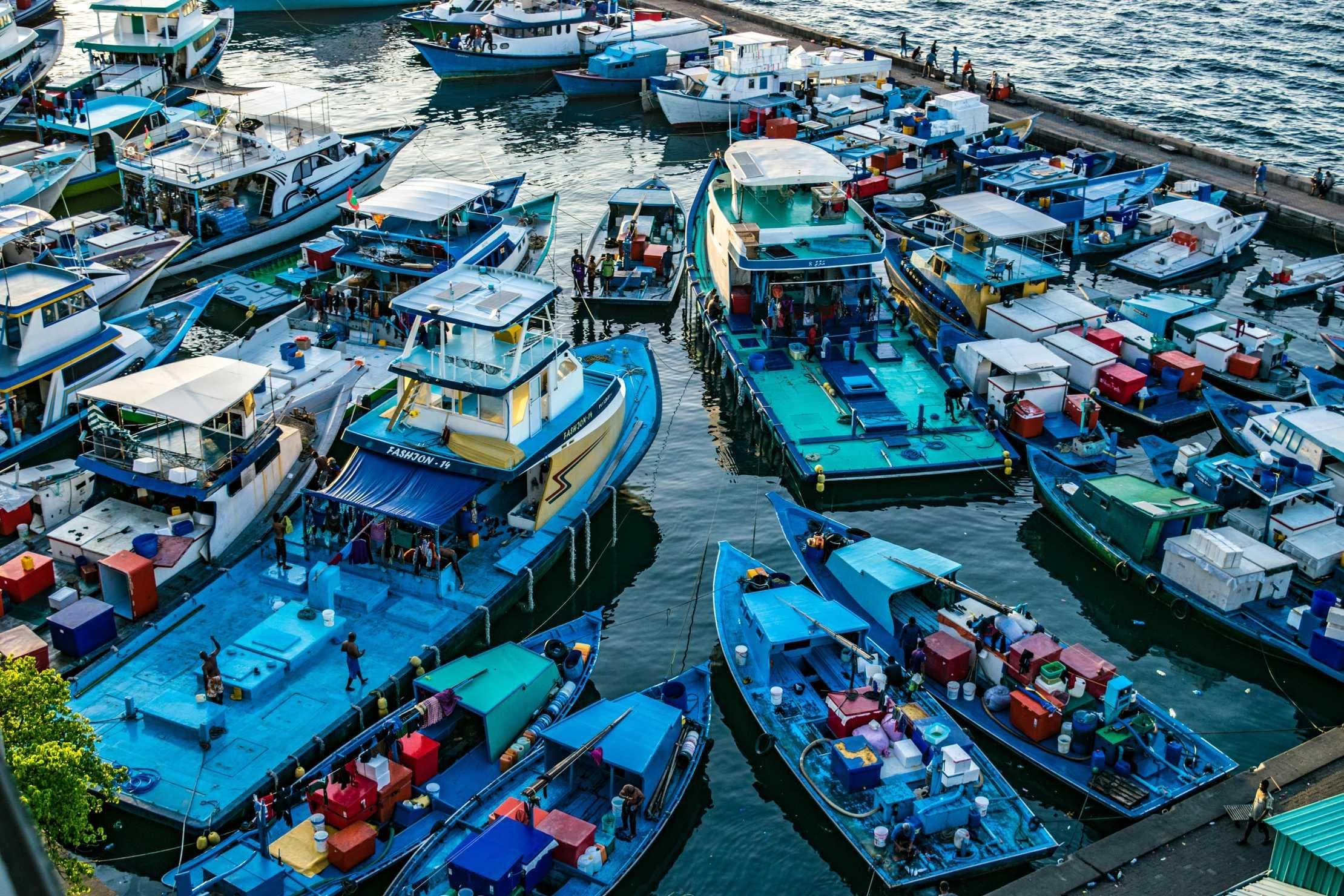
The Fish Market is one of the most dramatic and authentic experiences in the Maldivian capital. Every morning, fishermen return from the Indian Ocean with their catch — predominantly skipjack and yellowfin tuna — and the market erupts into a fast, skilled, centuries-old ritual of cleaning, cutting, and selling. Tuna is not just food in the Maldives — it is culture, identity, and economy, all in one. Standing here, you see exactly how this island nation has fed and sustained itself for over a thousand years.
Situated along the seafront on Boduthakurufaanu Magu, the Presidential Office enjoys one of the most commanding positions in Malé — overlooking the harbour and the open Indian Ocean. The colonial-era architecture is among the most photographed in the city, and the waterfront setting makes it an ideal place to stop for photos and take in the contrast between Malé's dense interior streets and the wide horizon just beyond. Your guide will explain the building's role in modern governance and its connections to Maldivian political history.
The King Salman Mosque is the largest mosque in the Indian Ocean — a landmark that reshapes the Malé skyline and the city's spiritual identity. Funded by the Kingdom of Saudi Arabia and completed in 2022, it can accommodate up to 10,000 worshippers and features five soaring minarets representing the five pillars of Islam, alongside a striking tent-like roof inspired by Bedouin architecture. The complex includes a library, classrooms, and an auditorium. Standing on the seafront, it is a powerful symbol of the Maldives' deep Islamic heritage and its place within the global Muslim community.
The tour ends at Artificial Beach — a man-made lagoon and beachfront in the Henveiru district that has become one of Malé's most beloved public spaces. Locals come here in the evenings to swim, walk, and gather with friends and family. For a moment, you can do the same: sit by the water, look back at the Malé skyline, and reflect on everything you've experienced in the last three hours. It's a calm, beautiful ending to an immersive day in the Maldives capital.
Know before you go
Not allowed
- Smoking during the tour
- Drones or professional camera equipment without prior written approval
What to Bring
- Comfortable, closed-toe walking shoes
- Sunscreen and a hat
- Water bottle
- Modest clothing — covered shoulders and knees required at mosque sites
- Booking voucher (printed or on mobile device)
Good to know
- Guests with limited mobility or in wheelchairs (the route includes uneven terrain and narrow streets)
- Those unable to walk 2–3 km at a moderate pace
Your guide will be waiting at the Henveiru Ferry Terminal, directly opposite the Maagiri Hotel on the Malé waterfront. If arriving from Velana International Airport, take the airport ferry to Malé (5–10 minutes) — the terminal is a short walk from the Malé ferry jetty. If you need a pickup from your hotel or guesthouse within Malé City, you can request this when booking.
Yes — the tour is fully family-friendly and welcomes guests of all ages, including babies and toddlers. The route is mostly flat and on paved streets. Our guides are experienced at tailoring the pace and stories for younger children. For large families we can arrange additional guides. Please mention any special requirements — including ages of children or pushchair needs — at the time of booking.
Photography is welcome throughout the tour. At mosque sites, exterior and grounds photography is fine — please avoid flash inside and be respectful of worshippers. Some government buildings do not permit interior photography; your guide will advise you on the spot. Tripods are not practical in busy market areas.
The tour runs in all weather. Malé's compact layout means many stops have natural shelter, including the covered fish market and local market. Your guide carries ponchos for unexpected showers. We only cancel in the event of extreme weather or government advisories — in which case you will be offered a full reschedule or refund at no penalty.
Wear light, breathable clothing that covers your shoulders and knees — this is required at mosque sites and respectful throughout the tour. Comfortable, closed-toe walking shoes are essential as you will cover 2–3 km on foot. Bring sunscreen, a hat, and a water bottle. During the wet season (May–October), a light rain jacket or compact umbrella is worth packing.
The tour covers approximately 2–3 km on mostly flat, paved streets at a relaxed pace, with regular stops and seated breaks. It is suitable for most fitness levels and is pushchair-friendly on the majority of the route. The tour is not suitable for wheelchair users due to some narrow streets and uneven surfaces. If you have any mobility concerns, please let us know at booking and we will do our best to accommodate you.
Yes — stopping at the Local Market and Fish Market is part of the experience. You are welcome to browse, buy, and try local snacks. Fresh coconuts, tropical fruits, Maldivian short-eats, and local crafts are all available. We recommend bringing Maldivian Rufiyaa or small US dollar bills as most stalls do not accept cards. Your guide will recommend the best stalls and help you navigate prices.
Free cancellation and rescheduling is available up to 24 hours before your tour start time. Cancellations made within 24 hours are subject to a 50% fee. In the event of extreme weather, government advisories, or circumstances beyond our control, you will be offered a full reschedule or refund. To cancel or reschedule, please contact us as early as possible using the details on your booking confirmation.
Yes — we offer both shared group tours and fully private tours. Our private Malé City walking tour gives your group an exclusive dedicated guide, complete flexibility on pace and focus, and a more personal experience overall. We also accommodate very large groups (up to 100+ guests) by providing additional guides as needed. Private tours can be tailored to your interests — just reach out with your requirements when booking.
Malé's streets are dense, signage is minimal, and the best stories hide behind buildings that look ordinary from the outside. A self-guided walk will get you to the landmarks — but without a local guide, you will miss the 1153 AD Islamic conversion story at Medhuziyaraiy, the cowrie shell currency history at the MMA, the political drama at the People's Majlis, and the cultural context that makes everything make sense. Our guides are certified, born-in-Maldives locals who bring this city to life in a way no map or phone app ever can.
Starting from
$44/ person
Date
Select a date
3 hrs
Reserve now, pay later
Secure your spot now and settle payment on the day of your activity
Instant confirmation
Get your booking confirmed immediately after reservation
Reviews
4.9/ 5
Based on 33 reviews
From
$44